October 3rd, 2017
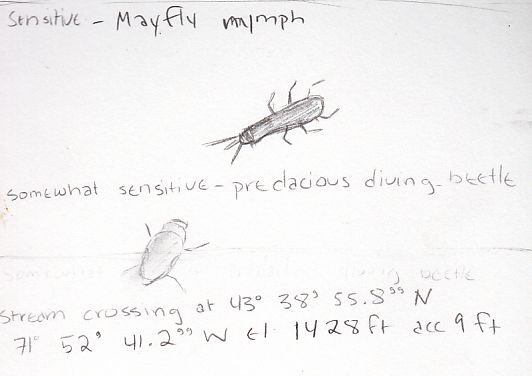
Image of sensitive and somewhat sensitive organisms found in the stream:
She dug out the nets and we divided into smaller groups to swipe at the water and attempt to identify our captives. We found one - a mayfly nymph. That organism is labeled as 'sensitive' which means that it is sensitive to pollution. The presence of this organism is H/EI, or more specifically, the lack of it. There was no pollution in the stream, because the mayfly nymph thrived there. We were interacting with the environment as we temporarily captured the organisms, and as we stirred up the silt looking for them. When someone dropped their pencil in the stream, the deep water caused the need for our chaperone to enter the water to fish it out. If we had left it there, then we would have been interacting - and not in a good way - with the environment. The plastic mechanical pencil would have broken up into microplastics, which would then ruin the unpolluted aspect of the stream. We continued onwards, and a dam traversed the river as it flowed further. We, humans, built the dam. We interacted with the environment, blocking the river and creating a reservoir. Rachelle assigned us partners and told us to 'build a mountain.' We all tromped off to find our materials, and the available materials on the forest floor influenced our structure. Someone began ripping a dead tree apart, and Rachelle told them to stop, but to no avail. Obviously this is a very harmful interaction with the environment. It interrupted the natural decomposition process of the dead tree. When we finished our rather sloppy mountains, Rachelle sprayed water at them to see how they held up and how the water flowed. We turned around there, because of course we had wasted hours of our time and did not manage to complete a sufficient hike. We tromped back to the pond and ate lunch on the picnic tables around it. Those who dropped food were interacting with the environment as well: but not in a good way. Thankfully, it was retrieved, but if it hadn't been, the wildlife would have found it, eaten it, and become more or less dependable on humans for sustenance. We packed up our gear and drove away on the bus some minutes later. The road that cut through the wilderness was interacting with the environment - it was blocking the forest from continuing in an uninterrupted swath, and creating a way for loud, noisy, and polluting vehicles to access the wilderness. The bus that took us away was made with metal that was mined from the earth, ripping a hole in a mountain somewhere. The plastic in the bus was creating using oil that was obtained by drilling a hole in the earth. Some day the plastic will decompose, but not entirely, into little bits that will pollute the planet. The environment interacts with us, and we interact with the environment. Unfortunately, we often do more harm than good.
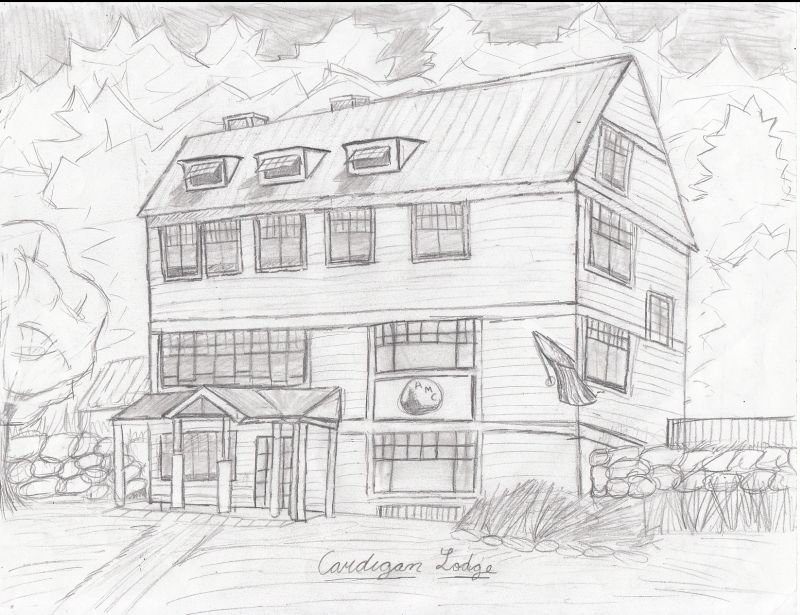
This is a sketch that I drew of Cardigan Lodge. Yes, those are supposed to be trees in the background.
MAP
This is a map of the path we walked on Day 3, October 3rd. It includes the Cardigan Region Forest Boundaries, a pushpin on Cardigan and Firescrew, and town boundaries outlined in orange.
To zoom in, press the shift key and draw a box around the area you wish to view.
To go back to the home page, click here.